Sample requests rarely feel like a problem at first, especially in packaging and labeling teams.
A customer asks for samples. Sales passes the request along. Operations prepare them. A box goes out. The work gets done, so the process feels acceptable.
What makes sample tracking difficult is not a single failure. It is the slow accumulation of small inefficiencies that compound as volume increases and more people become involved. Most packaging and labeling companies experience this gradually, often without realizing that the process itself is what needs attention.
Samples sit in an awkward place inside the organization. They touch sales, customer service, technical teams, production, and logistics. Yet they are rarely owned end-to-end. Everyone contributes. No one sees the whole picture.
That is where friction starts to form.
How sample tracking actually breaks down
The first issue is how requests enter the organization.
Sample requests arrive through emails, forwarded threads, CRM notes, messages, and the occasional phone call. Each request looks slightly different, depending on who sent it and how familiar they are with the process. Over time, this creates uncertainty. Teams are not always sure which requests are active, which details are final, or who is responsible for the next step.
People ask for updates not because they are careless, but because there is no shared reference point.
The second issue is information loss between teams.
Sample requests often move faster than the information supporting them. Artwork may still be in progress. Quantities change. Deadlines shift. Shipping details arrive late. Each handoff introduces assumptions, and assumptions introduce rework.
The work still gets done, but it takes longer than it should. Small delays become normal. Stress builds quietly.
Visibility is the next thing to disappear.
Sales needs to know when samples ship so they can update customers. Operations needs to understand the workload and priorities. Management wants a basic sense of how much sample work the team is handling. Without a shared view, each group operates with partial information, and those partial views rarely align.
Shipping adds another layer. Tracking numbers live in inboxes or carrier portals. Delivery confirmation is inconsistent. Follow-up depends on memory rather than structure. Feedback from customers is captured informally, if at all.
Eventually, teams realize they cannot answer simple questions. Which samples led to real opportunities? Which product types convert best? How much time and effort do samples actually represent? Not because the data does not exist, but because it was never captured in one place.
Why spreadsheets feel like the obvious answer
At some point, most teams introduce a spreadsheet.
At first, it helps. There is one place to log requests. Status becomes visible. Ownership feels clearer. For small volumes, this can be enough.
But spreadsheets rely on manual updates and discipline. As more people touch the same file, consistency erodes. Follow-ups depend on reminders rather than structure. Reporting becomes fragile. Connecting sample activity to customer or opportunity data becomes difficult.
Spreadsheets are not wrong. They are simply a starting point.
What a realistic first step looks like
Improving sample tracking does not require a major system change on day one.
The most effective first step is often a simple one. A shared place where each sample request has a single row. Clear customer details. Clear sample requirements. A visible status. Shipping and follow-up tracked consistently.
This alone removes a surprising amount of friction. Fewer internal questions. Fewer missed details. More predictable flow.
It also makes the limits visible. Teams can see when volume increases, when coordination becomes harder, and when manual tracking starts to strain.
A simple way to start
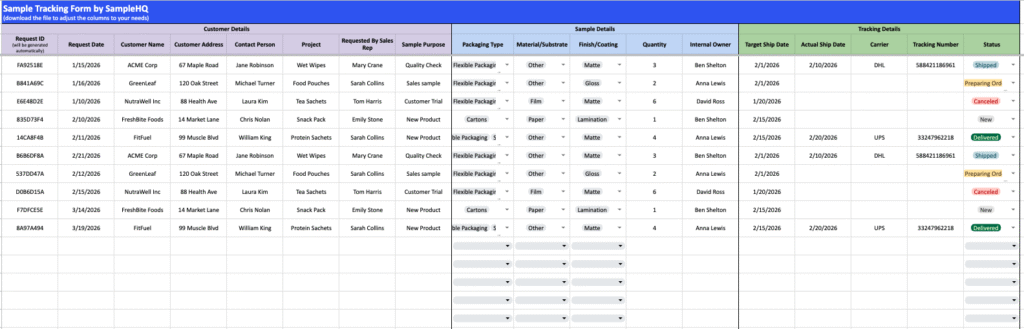
We have put together a simple Sample Management Sheet designed specifically for this stage.
It is intentionally straightforward. One row per request. Customer details, sample details, and tracking details in one place. No setup required.
It works well for small teams and manageable volumes, reflecting how samples actually move through an organization rather than how software assumes they should.
If sample tracking has started to feel harder than it should, this is a practical place to begin.
Excel file. Ready to use.
When teams outgrow spreadsheets
As sample volume grows, teams usually need more than a shared file.
They need a standardized intake so requests arrive complete. Shared visibility so sales, operations, and fulfillment stay aligned. Fewer manual updates. Better insight into what sample work actually leads to.
That is when spreadsheets begin to feel heavy. Not because they are bad tools, but because the process has outgrown them.
This is typically the point where teams start looking for a dedicated way to manage samples end-to-end.